Skip to content
Drug Law India
  • Home
  • Blog
  • Syllabus
  • All Lectures
  • LL.B. 3 Years Course Material
    • First Year (NEP)
      • Constitutional Law-1
    • Subject Browser
    • Subjectwise Syllabus Topic Browser
    • Model Questions
  • Bare Acts
    • Bare Acts (Domain wise)
    • Bare Acts List
    • Bare Acts List by Categories

Home » Who is a Hindu? Sources of Hindu Law

Bare Act

133
  • Protection of Women from Domestic Violence Act, 2005
  • Special Marriage Act, 1954
  • Muslim Women (Protection of Rights on Marriage) Act, 2019
  • Muslim Women (Protection of Rights on Divorce) Act, 1986
  • Dissolution of Muslim Marriages Act, 1939
  • Muslim Personal Law (Shariat) Application Act, 1937
  • Family Courts Act, 1984
  • Hindu Adoptions and Maintenance Act 1965
  • Hindu Minority and Guardianship Act, 1956
  • Hindu Succession Act, 1956
  • Hindu Marriage Act, 1956
  • Human Immunodeficiency Virus and Acquired Immune Deficiency Syndrome (Prevention and Control) Act, 2017
  • Mental Healthcare Act, 2017
  • The Transplant of Human Organs and Tissues Act, 1994
  • Pre-Conception and Pre-Natal Diagnostic Techniques (Prohibition of Sex Selection) Act, 1994
  • Protection of Human Rights, 1993
  • General Clauses Act, 1897
  • Constitution of India
  • Maharashtra Land Revenue Code, 1966
  • Maharashtra Co-operative Societies Act, 1960
  • Maharashtra Stamp Act, 1958
  • Maharashtra Regional and Town Planning Act, 1966
  • Maharashtra Municipal Corporations Act, 1949
  • Maharashtra Public Trusts Act, 1950
  • Maharashtra Rent Control Act, 1999
  • Public Liability Insurance Act, 1991
  • Hazardous and Other Wastes (Management and Transboundary Movement) Rules, 2015
  • Air (Prevention and Control of Pollution) Act, 1981
  • Water (Prevention and Control of Pollution) Act, 1974
  • Environment Protection Act, 1986
  • Protection of Plant Varieties and Farmers’ Rights Act, 2001
  • Biological Diversity Act, 2002
  • Designs Act, 2000
  • Copyright Act, 1957
  • The Patents Act, 1970
  • Trade Marks Act, 1999
  • Legal Metrology (Packaged Commodities) Rules, 2011
  • Legal Metrology Act, 2009
  • Income Tax Act, 1961
  • Indian Partnership Act, 1932
  • Companies Act, 2013
  • Limited Liability Partnership Act, 2008
  • Right to Information Act, 2005
  • Sales of Goods Act, 1930
  • Negotiable Instruments Act, 1881
  • Arbitration and Conciliation Act, 1996
  • Commercial Courts Act, 2015
  • Indian Contract Act, 1872
  • Specific Relief Act, 1963
  • Limitation Act, 1963
  • Code of Civil Procedure, 1908
  • Bharatiya Sakshya Adhiniyam, 2023
  • Bharatiya Nagarik Suraksha Sanhita, 2023
  • Bharatiya Nyaya Sanhita, 2023
  • Consumer Protection Act, 2019
  • Biomedical Waste Management Rules, 2016
  • Narcotic Drugs and Psychotropic Substances Act, 1985 with Rules
  • Drugs and Magic Remedies (Objectionable Advertisements) Act, 1954
  • Food Safety and Standards Act, 2006
  • Medical Termination of Pregnancy Act, 1971
  • National Medical Comission Act, 2019
  • Clinical Establishment (Registration and Regulation) Act
  • Pharmacy Practice Regulations
  • The Pharmacy Act, 1948
  • Cosmetic Rules, 2020
  • Drugs and Cosmetics Act, 1940 with Rules 1945
  • Drug, Pharmacy and Healthcare Laws
    • Human Immunodeficiency Virus and Acquired Immune Deficiency Syndrome (Prevention and Control) Act, 2017
    • Mental Healthcare Act, 2017
    • The Transplant of Human Organs and Tissues Act, 1994
    • Pre-Conception and Pre-Natal Diagnostic Techniques (Prohibition of Sex Selection) Act, 1994
    • Biomedical Waste Management Rules, 2016
    • Narcotic Drugs and Psychotropic Substances Act, 1985 with Rules
    • Drugs and Magic Remedies (Objectionable Advertisements) Act, 1954
    • Food Safety and Standards Act, 2006
    • Medical Termination of Pregnancy Act, 1971
    • National Medical Comission Act, 2019
    • Clinical Establishment (Registration and Regulation) Act
    • Pharmacy Practice Regulations
    • The Pharmacy Act, 1948
    • Cosmetic Rules, 2020
    • Drugs and Cosmetics Act, 1940 with Rules 1945
  • Consumer, Product Liability and Medical Negligence Laws
    • Consumer Protection Act, 2019
  • Criminal Laws
    • Bharatiya Sakshya Adhiniyam, 2023
    • Bharatiya Nagarik Suraksha Sanhita, 2023
    • Bharatiya Nyaya Sanhita, 2023
  • Civil Litigation and Procedural Laws
    • Sales of Goods Act, 1930
    • Negotiable Instruments Act, 1881
    • Arbitration and Conciliation Act, 1996
    • Commercial Courts Act, 2015
    • Indian Contract Act, 1872
    • Specific Relief Act, 1963
    • Limitation Act, 1963
    • Code of Civil Procedure, 1908
  • Constitutional and Administrative Law
    • Protection of Human Rights, 1993
    • General Clauses Act, 1897
    • Constitution of India
    • Right to Information Act, 2005
  • Intellectual Property and Pharmaceutical Innovation
    • Protection of Plant Varieties and Farmers’ Rights Act, 2001
    • Biological Diversity Act, 2002
    • Copyright Act, 1957
    • The Patents Act, 1970
    • Trade Marks Act, 1999
  • Business, Taxation and Compliance Laws
    • Designs Act, 2000
    • Legal Metrology (Packaged Commodities) Rules, 2011
    • Legal Metrology Act, 2009
    • Income Tax Act, 1961
    • Indian Partnership Act, 1932
    • Companies Act, 2013
    • Limited Liability Partnership Act, 2008
  • Environment, Public Health and Safety Laws
    • Public Liability Insurance Act, 1991
    • Hazardous and Other Wastes (Management and Transboundary Movement) Rules, 2015
    • Biomedical Waste Management Rules, 2016
    • Air (Prevention and Control of Pollution) Act, 1981
    • Water (Prevention and Control of Pollution) Act, 1974
    • Environment Protection Act, 1986
  • Maharashtra State Laws
    • Maharashtra Land Revenue Code, 1966
    • Maharashtra Co-operative Societies Act, 1960
    • Maharashtra Stamp Act, 1958
    • Maharashtra Regional and Town Planning Act, 1966
    • Maharashtra Municipal Corporations Act, 1949
    • Maharashtra Public Trusts Act, 1950
    • Maharashtra Rent Control Act, 1999
  • Family and Personal Laws
    • Protection of Women from Domestic Violence Act, 2005
    • Special Marriage Act, 1954
    • Muslim Women (Protection of Rights on Marriage) Act, 2019
    • Muslim Women (Protection of Rights on Divorce) Act, 1986
    • Dissolution of Muslim Marriages Act, 1939
    • Muslim Personal Law (Shariat) Application Act, 1937
    • Family Courts Act, 1984
    • Hindu Adoptions and Maintenance Act 1965
    • Hindu Minority and Guardianship Act, 1956
    • Hindu Succession Act, 1956
    • Hindu Marriage Act, 1956

Constitutional Law-1

26
  • List of Leading Cases in Constitutional Law-I
  • Historical Background to the Framing of the Indian Constitution
  • Preamble — Nature and Significance
  • Salient Features of the Constitution of India
  • Citizenship under the Indian Constitution [Part-II: Article 5-11]
  • State: Definition and Judicial Interpretation [Part-III: Article 12]
  • Judicial Review
  • Doctrine of Eclipse
  • Doctrine of Severability
  • Doctrine of Waiver (Rejected Doctrine)
  • Article 14: “Equality before law” vs “Equal protection of laws”
  • Arbitrariness
  • Reasonable Classification (Article 14) — Meaning and Test
  • Article 15 and Discrimination with Special Emphasis on Gender Discrimination
  • Freedom of Speech and its Resonable Restriction with special reference to Press and Media
  • Ex Post Facto Law, Its Prohibition and Rights of the Accused
  • Freedom of Movement: Meaning, Scope, and its Reasonable Restrictions
  • Right to Life and Liberty (Article 21)
  • Preventive Detention
  • Prohibition of Forced Labour and Child Labour
  • Secularism: A Indian Constitutional Law Perspective
  • Freedom of Religion (Articles 25–28)
  • Cultural Rights and Right to Minorities
  • Right to Education (RTE) in Indian Constitutional Law
  • Constitutional Remedies – Right to move Courts
  • Public Interest Litigation (PIL) in India — Origin, Scope, Purpose & Transformative Cases

Law of Torts

22
  • List of Leading Cases in Law of Torts
  • Evolution of Law of Torts, Common Law developments
  • Principles of Justice ,Equity and Good Conscience
  • Nature, Scope, Characteristics and Objects of Law of Torts
  • Distinction between Tort and Contract, Tort and Crime
  • Essential elements of Torts
  • Principles of Liability: Fault & No-fault Liability
  • Malfeasance, Misfeasance & Non-feasance
  • Motive, Intention, and Malice (Rea) in Tort Law
  • Justifications & General Defences In Tort
  • Extinguishment of Liability in the Law of Torts (Mechanisms of Discharge)
  • Capacity and Parties in Tort Law: Who May Sue and Who May Not Be Sued
  • The Tort of Defamation: Principles, Elements, and Defences
  • Trespass to Land and Trespass to Person: Principles, Elements, and Advanced Concepts
  • Negligence, Doctrine of Contributory Negligence, and Res Ipsa Loquitur
  • Nuisance: Public and Private: Principles, Elements, and Defences
  • State’s Liability and The Doctrine of Sovereign Immunity
  • Vicarious Liability
  • Strict Liability and Absolute Liability
  • The Doctrine of Causation
  • Remoteness of Damages
  • Judicial and Extra-Judicial Remedies in the Law of Torts

Law of Contract-1

21
  • List of Leading Cases covered in Law of Contract-I
  • Agreement vs Contract
  • What is Offer (Proposal)? What is Invitation to Treat / Invitation to Offer?
  • Acceptance and Essentials of Valid Acceptance
  • Consideration in a Contract
  • Competency to Contract
  • Consent and Free Consent
  • Unit-II
  • Contingent Contracts
  • Wagering Agreements
  • E-Contracts (Electronic Contracts)
  • Privity of Consideration
  • Doctrine of Privity of Contract
  • Privity of Contract vs Privity of Consideration
  • Legality of Object and Consideration
  • Agreement in Restraint of the Marriage
  • Performace and Discharge of Contract
  • Breach of Contract and Types of Breach
  • Remedies for Breach of Contract with Special Reference to Damage
  • Specific Performance as an Equitable Remedy
  • Injunctions

Family Law-1 (Hindu Law)

24
  • List of Leading Cases in Family Law-I (Hindu Law)
  • Who is a Hindu? Sources of Hindu Law
  • Mitakshara vs Dayabhaga Schools of Hindu Law
  • Doctrine of Pious Obligation in Ancient Hindu Law — Origin, Evolution, and Present Position
  • Key Sections of All 4 Hindu Acts
  • Registration of Hindu Marriages
  • Restitution of Conjugal Rights (RCR)
  • Judicial Separation (Section 9 – HMA)
  • Divorce under Hindu Law
  • Divorce by Mutual Consent (13B HMA)
  • Judicial Separation vs Divorce
  • Maintenance pendente lite under the Hindu Marriage Act (Section 24)
  • Permanent Alimony under the Hindu Marriage Act, 1955 (Section 25)
  • Family Courts Act, 1984
  • Role of NGOs and Lok Adalats in matrimonial dispute resolution in India
  • Dependents under HAMA, 1956
  • Maintenance of a Widowed Daughter-in-Law under Hindu Law
  • Capacity to give and Capacity to take for Adotion as per HAMA
  • Gifts, Wills, and Testamentary Succession
  • Devolution of property when a Hindu male dies intestate
  • Devolution of property when a Hindu Male dies intestate (presentation)
  • Devolution of property when a Hindu female dies intestate
  • Types of guardians under the Hindu Minority and Guardianship Act, 1956 (HMGA)
  • Uniform Civil Code: Constitutional Vision, Personal Laws and Judicial Discourse

Legal Language & Legal Writing

2
  • What is Law? Objectives of Law. Legal Terms and Legal Maxims. Model Synopsis (Q & A).
  • Legal Terms and Legal Maxims (Presentation)

Constitutional Law-2

4
  • Question and Answer Bank for Constitutional Law-II
  • Constitutional Law II notes
  • Summary of Articles in Constitutional Law-II for rapid revision
  • Comparison table of President and Governor for quick revision

Law of Crimes

4
  • Offences by and Against a Public Servant
  • BNS: Revision of important provisions
  • Law of crimes brief notes
  • Brief notes on Company Law

Family Law-2 (Muslim Law)

2
  • Notes on Muslim law
  • Question and Answers Bank for Muslim law

Law of Contract-2

1
  • Notes for Law of Contract II

Company Law

1
  • Company Law
View Categories

Who is a Hindu? Sources of Hindu Law

3 min read

Sources of Hindu Law #

1) Who is a Hindu? #

In Hindu law, “Hindu” is not confined to one prophet, one church, or one fixed creed. It is a broad religious–social category used to decide which personal law applies (marriage, succession, adoption, etc.).

Statutory definition of Hindu #

Section 2, Hindu Marriage Act, 1955 (similar “who is Hindu” coverage exists in other Hindu Code statutes) lays down that the Act applies to:

  1. Any person who is a Hindu by religion “in any of its forms or developments” (including Virashaiva, Lingayat, Brahmo, Prarthana, Arya Samaj);
  2. Any person who is a Buddhist, Jaina or Sikh by religion;
  3. Any other person domiciled in India who is not a Muslim, Christian, Parsi or Jew, unless it is proved that Hindu law would not have applied.
    It also includes as Hindus: children of Hindu parents (or one Hindu parent if brought up as such), and converts/re-converts to Hinduism.

2) Judicial precedents on “Who is Hindu” #

(i) Sastri Yagnapurushadji v. Muldas Bhudardas Vaishya (1966) — Swaminarayan/Satsangi case #

Facts: Followers of the Swaminarayan Sampradaya (Satsangis) sought to prevent entry of non-Satsangi Harijans into Swaminarayan temples. The dispute raised the claim that the sect was distinct from Hindu religion, so the “Hindu public worship/temple entry” law should not apply.
Issue: Whether the Swaminarayan sect is a religion separate from Hinduism, and whether its temples are Hindu temples for the relevant statute.
Held (ratio): The Supreme Court rejected the “separate religion” plea and held that Swaminarayan was a Hindu saint/reformer, and the sect is within Hindu religion; therefore, the temples fall within the statute.
Key reasoning: The Court noted that Hinduism historically absorbs reform movements; a sect may have distinctive rules, but if it subscribes to fundamental Hindu notions/philosophy, it remains within the Hindu fold. It relied on features like reverence for the Vedas and Bhakti path, and treated the sect’s openness to outsiders as consistent with Hindu thought that “many roads lead to God.”

(ii) Bramchari Sidheswar Bhai v. State of West Bengal (1995) — Ramakrishna Mission case #

Facts: The Ramakrishna Mission’s institutions claimed protection as a religious minority under Article 30(1), arguing “Ramakrishna religion” is distinct from Hinduism.
Issue: Whether followers of Ramakrishna form a minority religion distinct from Hinduism (hence entitled to Article 30(1) protection as a minority).
Held: The Supreme Court held that followers of Ramakrishna cannot claim to belong to a minority based on a religion “distinct and different” from Hinduism; the “Ramakrishna religion as a separate minority religion” claim was rejected.

(iii) Perumal Nadar (Dead) v. Ponnuswami (1970) — conversion/validity of marriage and status #

Facts: A dispute arose questioning the validity of a marriage and legitimacy of a child, including issues around personal law applicability and the parties’ status.
Issue: Among other points, whether the marriage/child’s status could be attacked on personal-law grounds (including arguments about domicile/status).
Held: The Supreme Court rejected the illegitimacy contention and proceeded on the basis of a valid marriage and strong presumptions supporting legitimacy when a child is born during subsistence of marriage (Evidence Act, s.112), unless non-access is clearly proved.

3) What is Hindu Law? #

John D. Mayne explains that “Hindu law is the law of the Smritis, as expounded in the Sanskrit commentaries and digests, modified and supplemented by custom, and administered by the courts.”

4) Sources of Hindu Law #
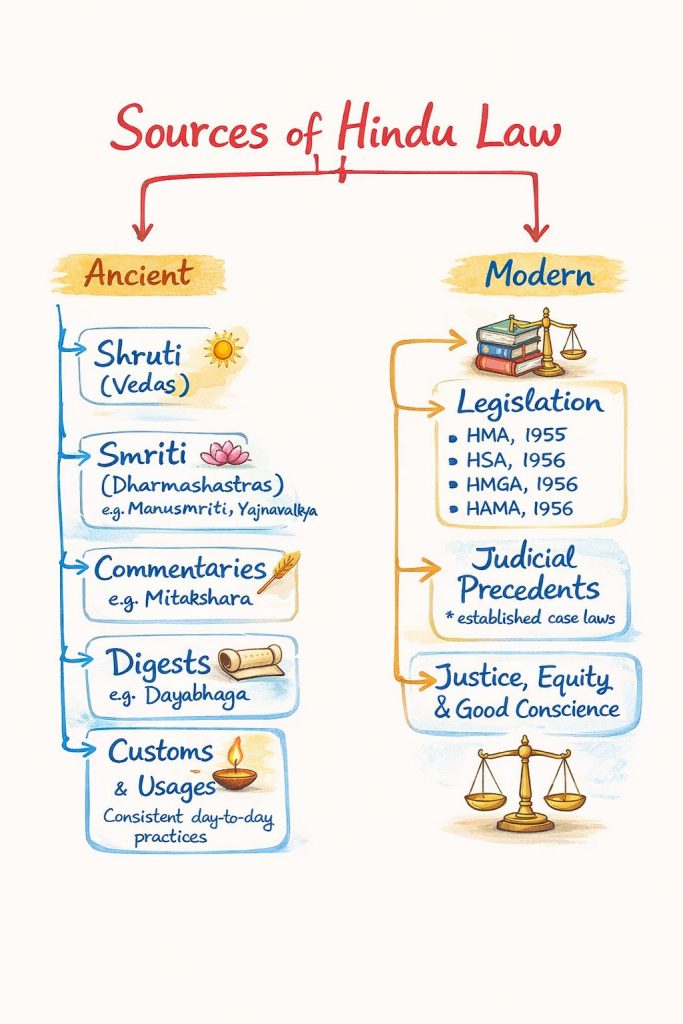
A) Ancient (Traditional) Sources #

  1. Shruti (Vedas)
    Believed to be highest spiritual authority. In practical adjudication, Shruti is more foundational than directly applied as rules.
  2. Smriti (Dharmashastras)
    “Remembered” texts like Manusmriti, Yajnavalkya Smriti, Narada Smriti, etc. They historically supplied rules on marriage, inheritance, penance, duties.
  3. Commentaries & Digests
    Because Smritis sometimes conflicted, jurists produced interpretative works:
    • Mitakshara (commentary)
    • Dayabhaga (digest)
      These shaped regional schools (Mitakshara across most of India; Dayabhaga in Bengal) especially in coparcenary and succession.
  4. Customs and Usages
    Custom is a crucial source—often stronger than text in many matters (especially local family/community practices).
    Validity conditions: a custom must generally be ancient, certain, reasonable, continuously and uniformly observed, and not opposed to public policy or morality, and (after codification) not contrary to statute.

B) Modern Sources #

  1. Legislation (Codified Hindu Law) — Primary today
    The Hindu Code statutes are the dominant source, including:
    • Hindu Marriage Act, 1955
    • Hindu Succession Act, 1956
    • Hindu Minority and Guardianship Act, 1956
    • Hindu Adoptions and Maintenance Act, 1956
      Rule: If a matter is covered by statute, statute prevails; old textual law is used mainly where statute is silent.
  2. Judicial Precedents
    Case law is a living source because Hindu law has evolved through interpretation—especially on:
    • meaning of “Hindu” and scope of Hinduism (e.g., Swaminarayan case)
    • status of denominations/sects and their placement within Hindu fold (e.g., Ramakrishna Mission case)
    • application of personal-law principles to disputes of status, marriage, legitimacy, etc.
  3. Justice, Equity and Good Conscience
    Historically used (especially during British administration) where no clear rule existed. Even now, courts may apply equitable principles to fill gaps, but always subject to statute and binding precedent.

5) Conclusion #

Hindu law today is a mixed system: historically rooted in Shruti–Smriti–commentaries-digests and custom, but presently governed mainly by codified legislation, interpreted and developed by judicial precedents. The threshold question—“Who is a Hindu?”—is answered primarily through Section 2–type statutory tests and reinforced by Supreme Court rulings which treat Hinduism as a broad, inclusive tradition capable of accommodating sects and reform movements (e.g., Swaminarayan and Ramakrishna Mission decisions).

Updated on 20 January 2026
Family Law I (Hindu Law) Hindu Law Sources of Hindu Law Who is a Hindu

What are your Feelings

  • Happy
  • Normal
  • Sad

Share This Article :

  • Facebook
  • X
  • LinkedIn
  • Pinterest
List of Leading Cases in Family Law-I (Hindu Law)Mitakshara vs Dayabhaga Schools of Hindu Law

Powered by BetterDocs

Leave a comment Cancel reply

Table of Contents
  • Sources of Hindu Law
    • 1) Who is a Hindu?
      • Statutory definition of Hindu
    • 2) Judicial precedents on “Who is Hindu”
      • (i) Sastri Yagnapurushadji v. Muldas Bhudardas Vaishya (1966) — Swaminarayan/Satsangi case
      • (ii) Bramchari Sidheswar Bhai v. State of West Bengal (1995) — Ramakrishna Mission case
      • (iii) Perumal Nadar (Dead) v. Ponnuswami (1970) — conversion/validity of marriage and status
      • 3) What is Hindu Law?
  • 4) Sources of Hindu Law
    • A) Ancient (Traditional) Sources
    • B) Modern Sources
  • 5) Conclusion

© 2026 Drug Law India. All rights reserved.

Drug Law India is an independent legal education platform providing information on Indian drug laws, pharmaceutical regulations, public health laws, case law, bare acts, and legal learning resources.
The content on this website is for educational and informational purposes only and does not constitute legal advice, medical advice, pharmaceutical advice, or regulatory consultancy.

About | Contact | Privacy Policy | Disclaimer | Terms of Use