
Family Law I · Hindu Law
Sources of Hindu Law
Hindu Law has developed through ancient religious and juristic texts, long-recognised customs, modern legislation, judicial interpretation, and principles of justice, equity and good conscience.
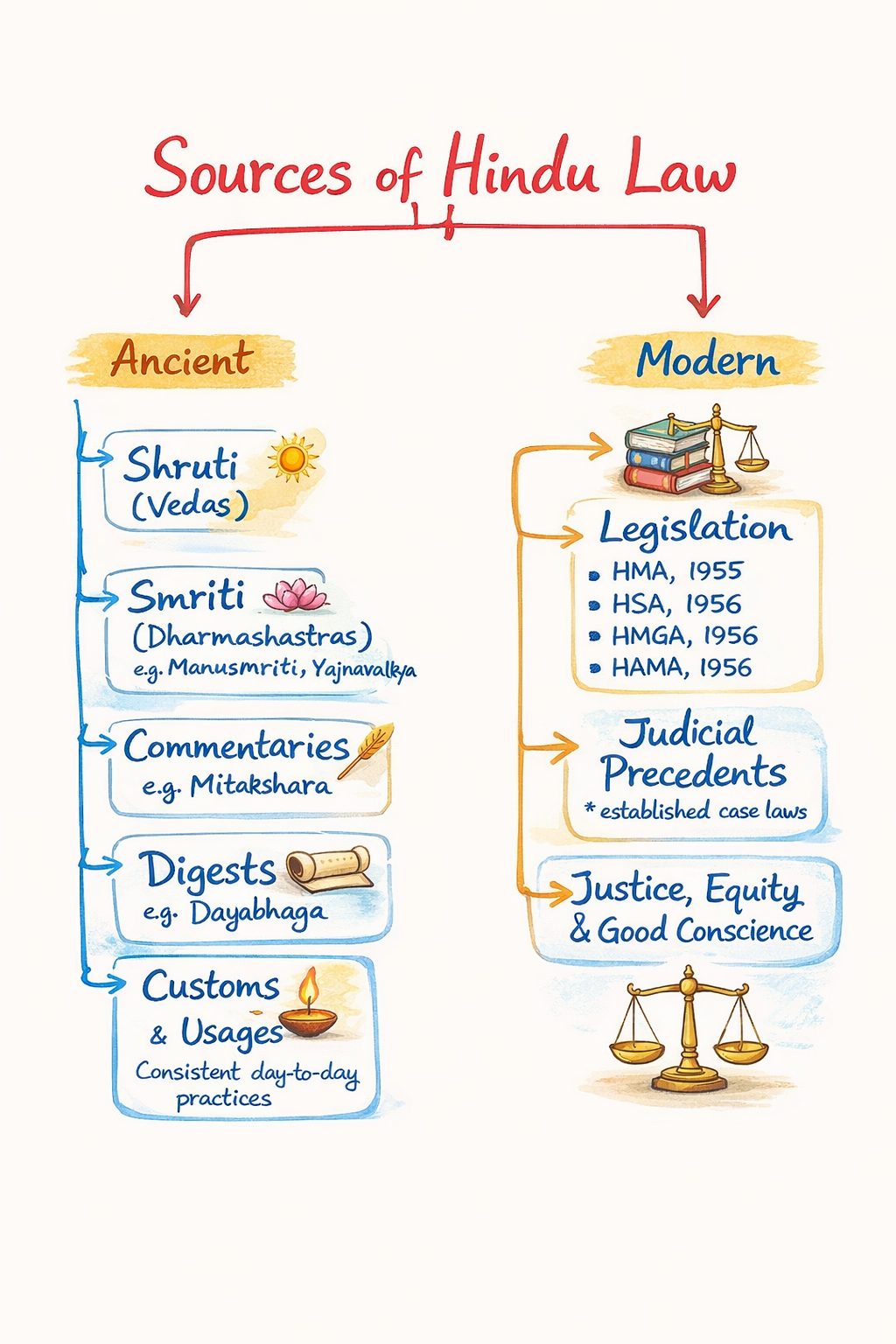
Understanding the Sources
The sources of Hindu Law may broadly be classified into Ancient or Traditional Sources and Modern Sources. Ancient sources explain the historical, religious, textual and customary foundation of Hindu Law. Modern sources, especially legislation and judicial precedents, are the primary sources applied by courts today.
After codification, statutory law prevails wherever the matter is covered by legislation. Ancient texts and customs continue to have relevance mainly where the statute is silent, or where their application is recognised by law.
Ancient Sources
Traditional sources based on religious texts, juristic interpretation and established practices.
Shruti (Vedas)
Shruti is regarded as the highest spiritual authority. In practical adjudication, however, Shruti is more foundational than directly applied as a detailed body of legal rules.
Smriti (Dharmashastras)
Smriti means “remembered” texts. Works such as Manusmriti, Yajnavalkya Smriti and Narada Smriti historically supplied rules on marriage, inheritance, penance, duties and social conduct.
Commentaries and Digests
Since Smritis were sometimes conflicting or difficult to apply, jurists prepared interpretative works. Important examples include Mitakshara and Dayabhaga.
These works shaped regional schools of Hindu Law. Mitakshara influenced most of India, while Dayabhaga became important in Bengal, especially in matters of coparcenary and succession.
Customs and Usages
Custom is a crucial source of Hindu Law. In many family and community matters, a valid custom may have stronger practical force than textual law.
Modern Sources
Sources applied by modern courts, especially after codification of Hindu personal law.
Legislation (Codified Hindu Law)
Legislation is the primary source of Hindu Law today. The Hindu Code statutes have substantially codified major areas of Hindu personal law.
- Hindu Marriage Act, 1955
- Hindu Succession Act, 1956
- Hindu Minority and Guardianship Act, 1956
- Hindu Adoptions and Maintenance Act, 1956
Judicial Precedents
Case law is a living source of Hindu Law. Courts have developed Hindu Law through interpretation, especially in questions relating to status, marriage, legitimacy, succession, religious denominations and the meaning of “Hindu”.
Important judicial discussions include the scope of Hinduism in the Swaminarayan case and the status of religious denominations in the Ramakrishna Mission case.
Justice, Equity and Good Conscience
This principle was historically used, especially during British administration, where no clear rule of Hindu Law existed.
Even today, courts may apply equitable principles to fill gaps, but such application must remain subject to statutory law and binding precedent.
Key Takeaways
Remember this simple structure: Ancient sources explain the origin and historical foundation of Hindu Law, while modern sources govern its present-day application.
Ancient Sources
Shruti, Smriti, Commentaries, Digests, Customs and Usages.
Modern Sources
Legislation, Judicial Precedents, and Justice, Equity and Good Conscience.