Sources of Hindu Law #
1) Who is a Hindu? #
In Hindu law, “Hindu” is not confined to one prophet, one church, or one fixed creed. It is a broad religious–social category used to decide which personal law applies (marriage, succession, adoption, etc.).
Statutory definition of Hindu #
Section 2, Hindu Marriage Act, 1955 (similar “who is Hindu” coverage exists in other Hindu Code statutes) lays down that the Act applies to:
- Any person who is a Hindu by religion “in any of its forms or developments” (including Virashaiva, Lingayat, Brahmo, Prarthana, Arya Samaj);
- Any person who is a Buddhist, Jaina or Sikh by religion;
- Any other person domiciled in India who is not a Muslim, Christian, Parsi or Jew, unless it is proved that Hindu law would not have applied.
It also includes as Hindus: children of Hindu parents (or one Hindu parent if brought up as such), and converts/re-converts to Hinduism.
2) Judicial precedents on “Who is Hindu” #
(i) Sastri Yagnapurushadji v. Muldas Bhudardas Vaishya (1966) — Swaminarayan/Satsangi case #
Facts: Followers of the Swaminarayan Sampradaya (Satsangis) sought to prevent entry of non-Satsangi Harijans into Swaminarayan temples. The dispute raised the claim that the sect was distinct from Hindu religion, so the “Hindu public worship/temple entry” law should not apply.
Issue: Whether the Swaminarayan sect is a religion separate from Hinduism, and whether its temples are Hindu temples for the relevant statute.
Held (ratio): The Supreme Court rejected the “separate religion” plea and held that Swaminarayan was a Hindu saint/reformer, and the sect is within Hindu religion; therefore, the temples fall within the statute.
Key reasoning: The Court noted that Hinduism historically absorbs reform movements; a sect may have distinctive rules, but if it subscribes to fundamental Hindu notions/philosophy, it remains within the Hindu fold. It relied on features like reverence for the Vedas and Bhakti path, and treated the sect’s openness to outsiders as consistent with Hindu thought that “many roads lead to God.”
(ii) Bramchari Sidheswar Bhai v. State of West Bengal (1995) — Ramakrishna Mission case #
Facts: The Ramakrishna Mission’s institutions claimed protection as a religious minority under Article 30(1), arguing “Ramakrishna religion” is distinct from Hinduism.
Issue: Whether followers of Ramakrishna form a minority religion distinct from Hinduism (hence entitled to Article 30(1) protection as a minority).
Held: The Supreme Court held that followers of Ramakrishna cannot claim to belong to a minority based on a religion “distinct and different” from Hinduism; the “Ramakrishna religion as a separate minority religion” claim was rejected.
(iii) Perumal Nadar (Dead) v. Ponnuswami (1970) — conversion/validity of marriage and status #
Facts: A dispute arose questioning the validity of a marriage and legitimacy of a child, including issues around personal law applicability and the parties’ status.
Issue: Among other points, whether the marriage/child’s status could be attacked on personal-law grounds (including arguments about domicile/status).
Held: The Supreme Court rejected the illegitimacy contention and proceeded on the basis of a valid marriage and strong presumptions supporting legitimacy when a child is born during subsistence of marriage (Evidence Act, s.112), unless non-access is clearly proved.
3) What is Hindu Law? #
John D. Mayne explains that “Hindu law is the law of the Smritis, as expounded in the Sanskrit commentaries and digests, modified and supplemented by custom, and administered by the courts.”
4) Sources of Hindu Law #
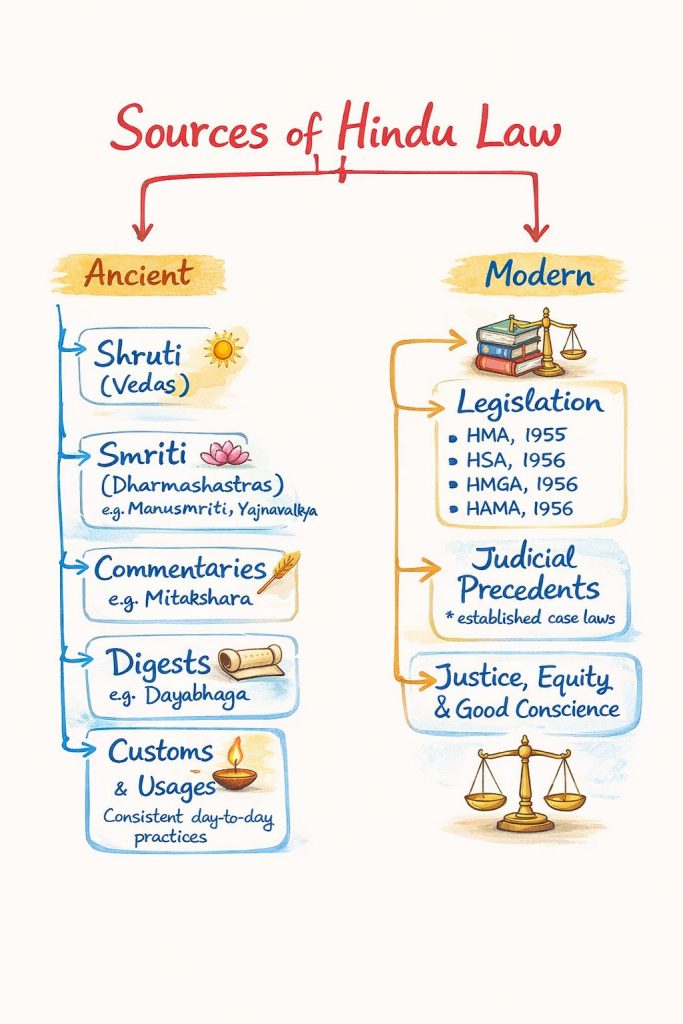
A) Ancient (Traditional) Sources #
- Shruti (Vedas)
Believed to be highest spiritual authority. In practical adjudication, Shruti is more foundational than directly applied as rules. - Smriti (Dharmashastras)
“Remembered” texts like Manusmriti, Yajnavalkya Smriti, Narada Smriti, etc. They historically supplied rules on marriage, inheritance, penance, duties. - Commentaries & Digests
Because Smritis sometimes conflicted, jurists produced interpretative works:- Mitakshara (commentary)
- Dayabhaga (digest)
These shaped regional schools (Mitakshara across most of India; Dayabhaga in Bengal) especially in coparcenary and succession.
- Customs and Usages
Custom is a crucial source—often stronger than text in many matters (especially local family/community practices).
Validity conditions: a custom must generally be ancient, certain, reasonable, continuously and uniformly observed, and not opposed to public policy or morality, and (after codification) not contrary to statute.
B) Modern Sources #
- Legislation (Codified Hindu Law) — Primary today
The Hindu Code statutes are the dominant source, including:- Hindu Marriage Act, 1955
- Hindu Succession Act, 1956
- Hindu Minority and Guardianship Act, 1956
- Hindu Adoptions and Maintenance Act, 1956
Rule: If a matter is covered by statute, statute prevails; old textual law is used mainly where statute is silent.
- Judicial Precedents
Case law is a living source because Hindu law has evolved through interpretation—especially on:- meaning of “Hindu” and scope of Hinduism (e.g., Swaminarayan case)
- status of denominations/sects and their placement within Hindu fold (e.g., Ramakrishna Mission case)
- application of personal-law principles to disputes of status, marriage, legitimacy, etc.
- Justice, Equity and Good Conscience
Historically used (especially during British administration) where no clear rule existed. Even now, courts may apply equitable principles to fill gaps, but always subject to statute and binding precedent.
5) Conclusion #
Hindu law today is a mixed system: historically rooted in Shruti–Smriti–commentaries-digests and custom, but presently governed mainly by codified legislation, interpreted and developed by judicial precedents. The threshold question—“Who is a Hindu?”—is answered primarily through Section 2–type statutory tests and reinforced by Supreme Court rulings which treat Hinduism as a broad, inclusive tradition capable of accommodating sects and reform movements (e.g., Swaminarayan and Ramakrishna Mission decisions).


